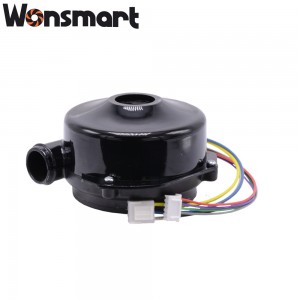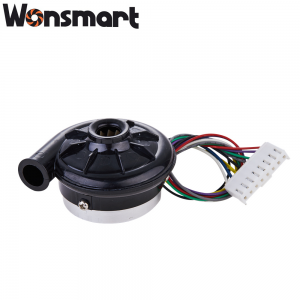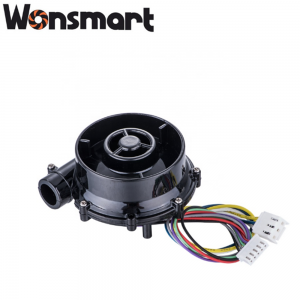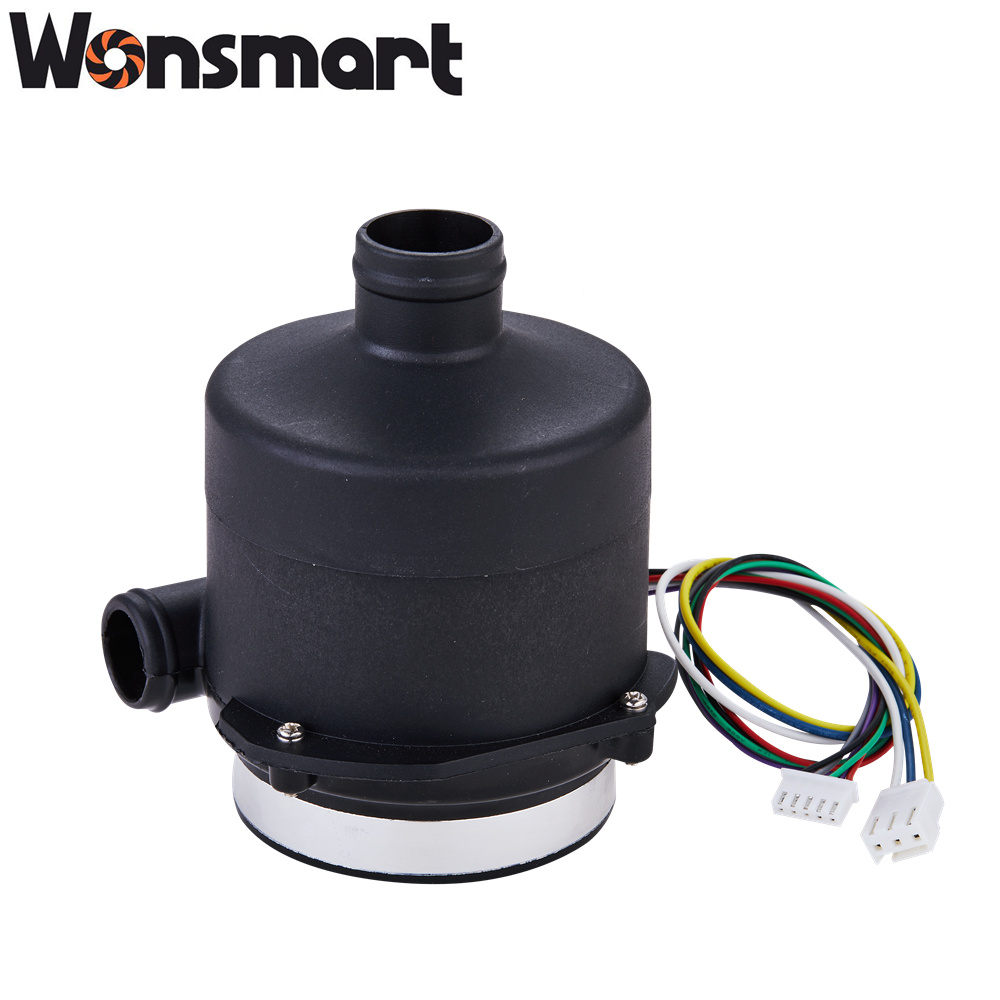


12V DC Air Diffuser Brushless Cooling Fan Centrifugal Electric Blower
12V DC Air Brushless Cooling Fan
01 | High Airflow up to 50 m³/h
Delivers up to 50 m³/h airflow, providing powerful air delivery for applications requiring high-volume airflow.
02 | High Static Pressure up to 10.5 kPa
Provides up to 10.5 kPa static pressure, making it suitable for demanding systems with high airflow resistance.
03 | Powerful Performance at 12VDC
With a 12VDC power supply and up to 252W power, the blower delivers strong performance while maintaining a compact centrifugal design.
04 | High-Speed Brushless Motor
Powered by a three-phase BLDC motor operating at up to 25,000 rpm, providing fast and stable airflow performance.
05 | Reliable NMB Ball Bearings
Equipped with NMB ball bearings, designed for reliable long-term operation. The model is specified for a service life of up to 15,000 hours at 25°C rated operation under the stated conditions
Product Introduction
| Part no | WS9290B-12-220-S200 |
| Voltage | 12VDC |
| At max airflow | |
| Speed | 22000rpm |
| Current | 15a |
| Air flow | 50m3/h |
| Noise | 83dba |
| At max air pressure | |
| Speed | 25000rpm |
| Current | 8a |
| Air pressure | 10.5kpa |
| Noise | 65dba |
| Block | 58dba |
Drawing

Blower Performance
WS9290B-12-220-S200 blower can reach maximum 50m3/h airflow at 0 kpa pressure and maximum 10.5kpa static pressure.Other load point performance refer to below P-Q curve:
| Model:WS9290B-12-220-S200 | Voltage:12VDC | Weight:490g | Size:92*90mm |
| Air pressure(kPa) | Air flow(m3/h) | Speed (r/min) | Power(W) |
| 0 | 50.0 | 22,000 | 180.0 |
| 7.0(Working point) | 40.0 | 24,000 | 150.0 |
| 10.5 | 0 | 25,000 | 252.0 |

DC Brushless Blower Advantage
Wonsmart BLDC centrifugal blowers combine high efficiency, long service life, precise speed control, and compact design to deliver reliable airflow for demanding applications. Unlike traditional brushed motors, BLDC motors eliminate mechanical brushes, reducing wear and maintenance while enabling smooth, high-speed operation. Electronic commutation also allows flexible speed control and fast response to changing airflow requirements, making BLDC blowers an ideal choice for medical equipment, ventilation systems, electronics cooling, air sampling, and industrial applications.
FAQ
Q1: Is Wonsmart a manufacturer or a trading company?
A: Wonsmart is a professional manufacturer specializing in BLDC centrifugal blowers and motors. We have our own production facility in Ningbo, China, with automated production and testing equipment to ensure stable quality and reliable performance.
Q2: What is the MOQ for Wonsmart blowers?
A: Our standard MOQ is 1 piece. Customers can purchase samples for testing and evaluation before placing larger production orders.
Q3: Do I need a driver for the Wonsmart blower?
A: Most Wonsmart BLDC blowers require a matched external driver to operate. Depending on the model, speed can be controlled by PWM, analog voltage, or a potentiometer. Some models have a built-in driver and can be connected directly to a DC power supply.
Q4: How can I choose the right Wonsmart blower for my application?
A: Please provide your required airflow, air pressure, voltage, installation space, noise requirement, and application. Our technical team can recommend the most suitable blower and driver combination according to your needs.
Q5: Can Wonsmart provide customized solutions?
A: Yes. Wonsmart supports customized solutions, including special performance requirements, voltage, wiring length, connectors, driver functions, and other project-specific modifications. Please contact us with your detailed requirements for evaluation.
The flow rate (typically: liters per minute), at which a blower supplies air or another respiratory gas to the system, depends on the resistance to the flow (also referred to as "static pressure" or "system pressure") that the blower has to overcome.A specific value of the flow rate corresponds to a specific value of the resistance for a specific fan speed (revolutions per minute). A particular type of blower is characterized by a set of curves in a Cartesian space spanned by a first axis, each particular point whereof corresponds to a particular value of the flow rate, and a second axis, of which each particular point corresponds to a particular value of the resistance . Each specific one of the curves corresponds to a specific value of the fan speed. For, e.g., a radial blower, the curves are largely uniform, and offset with regard to one another in the direction of the second axis. For additional technical information see, e.g., "Fan Fundamentals: Fan Selection, Application-Based Selection, Performance Theory", Rev 2, June 2005, Greenheck Fan Corp.
The blower is not an ideal pressure source, because the flow rate decreases with increasing system pressure (or: resistance to the flow). As a result, the flow rate is sensitive to fluctuations in the system pressure. Fig.1 is a diagram 100 of a typical fan curve 102 illustrating this sensitivity. Curve 100 represents the dependence of the flow rate (horizontally, in liters per minute) on the system pressure (vertically, in mbar) at a particular fan speed. In principle, the blower can be used to control the flow rate, but the flow rate varies with varying system pressures. For example, if the system pressure varies between 55 mbar and 60 mbar, the flow rate fluctuates between 5 l/sec and 40 l/sec in the example illustrated.